Dr Johnny Ryan FRHistS is a Senior Fellow at the Irish Council for Civil Liberties, and a Senior Fellow at the Open Markets Institute in the United States. He works on policy, regulation, data, privacy, innovation, design, and tech.
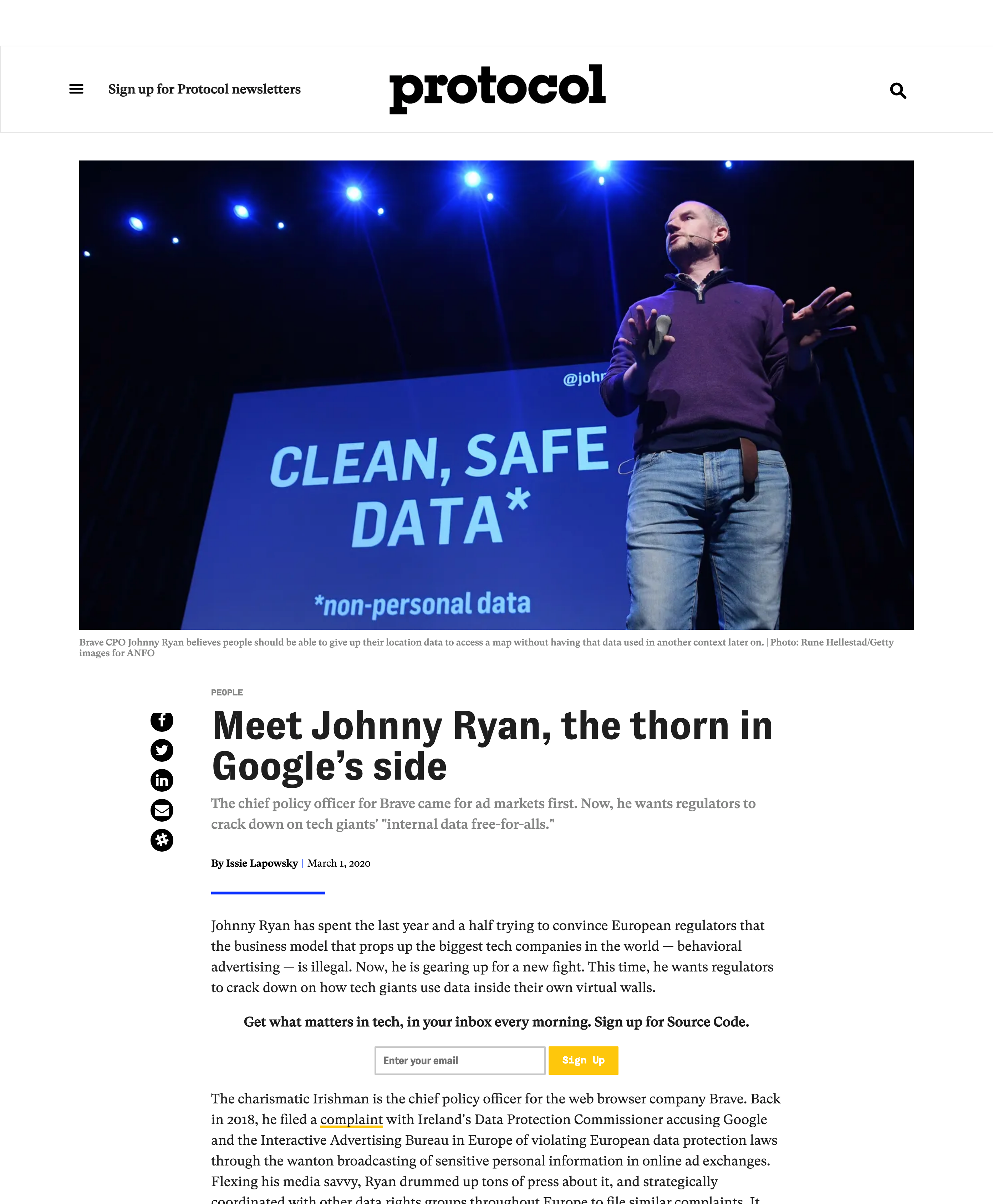
Previously, he was Chief Policy & Industry Relations Officer at Brave, the private web browser. At Brave, Dr Ryan led a campaign for GDPR enforcement across the EU, and liaised with global government and industry leaders. His regulatory interventions have made the front page of The Financial Times, and his expert commentary on the data and privacy regularly appears in media such as The New York Times, The Economist, Wired, Le Monde, and others. Protocol published a profile about some of his work.
Like many Brave employees, he suffers from a syndrome called “adtech remorse”. Before Brave, Dr. Ryan worked in adtech, media, and policy. His previous roles included Chief Innovation Officer of The Irish Times and Senior Researcher at the Institute of International & European Affairs (IIEA).
Dr Ryan is a regular speaker at high level industry fora, and has testified at the United States Senate and the European Commission.
As an O’Reilly Foundation PhD scholar at the University of Cambridge he studied the spread of militant memes. Dr Ryan is the author of two books (link: “A History of the Internet and the Digital Future”). His first book, based on his work at the IIEA, was the most cited source in the European Commission’s impact assessment that decided against pursuing Web censorship across the EU.
He is a Fellow of the Royal Historical Society, and a member of the World Economic Forum’s expert network on media, entertainment and information.
He started his career in design, and returned to design thinking later as Executive Director of The Innovation Academy at University College Dublin. He was an associate on the emerging digital environment at the Judge Business School of the University of Cambridge.
Selected press mentions



Press photographs





Selected press mentions
(Last updated 10 August 2021
August 2021
- Mlex, Comment: EU’s Facebook-Kustomer review echoes Google-Fitbit; controversy looms, 5 August 2021
July 2021
- Politico, EU steps up Big Tech crackdown with in-depth probe of latest Facebook deal, 30 July 2021
- The Irish Independent, TDs call for review of data protection agency, 23 July 2021
- Politiken, En angrende skurk: Mød en af Googles argeste modstandere, 11 July 2021
- Mi3, Privacy purge: EU mega lawsuit against IAB, Xandr aims to end behavioural targeting, real time ad bidding worldwide in three years: Dr Johnny Ryan, 5 July 2021
June 2021
- PC Magazine, Will Limiting Adtech Hurt Publishers? Nope, 28 June 2021
- (ICCL authored article) Cristina Caffarra, Johnny Ryan, Pro Market, Why Privacy Experts Need a Place at the Antitrust Table, 28 July 2021
- Der Spiegel, “Ein Ire verklagt die Schaltstellen der Werbeindustrie”, 17 July 2021
- Jurist, Irish Council for Civil Liberties suing over data privacy breaches, 19 June 2021
- Clubic, Une plainte a été déposée contre l’IAB Tech Lab et l’accuse de “la plus grande fuite de données au monde”, 16 June 2021
- The Canary, Civil liberties group takes aim at the secret dossiers internet firms keep on all of us, 18 June 2021
- AdExchanger, Antitrust Regulators Are Turning Up The Heat On Big Tech. Here’s Your Cheat Sheet 18 June 2021
- The Times, Irish Council for Civil Liberties targets digital advertising over privacy concerns, 17 June 2021
- The Irish Examiner, Lawsuit to tackle secret tracking in online advertising, 17 June 2021
- Die Zeit, Aktivist klagt vor Hamburger Landgericht gegen Onlinewerbung, 16 June 2021
- The Register, Ex-Brave staffer launches GDPR sueball in Germany over tech giants’ real-time bidding for ad inventory, 17 June 2021
- The Irish Times, Irish Council for Civil Liberties files privacy lawsuit over online ads, 16 June 2021
- The Irish Examiner, Irish civil liberties group accuses digital ad industry of major data breach, 16 June 2021
- L’usine digitale, Publicité en ligne : Les grandes entreprises technologiques sont accusées de violer le RGPD, 16 June 2021
- TechCrunch Adtech ‘data breach’ GDPR complaint is headed to court in EU, 16 June 2021
- SPORT.es, La industria de publicidad acusada de una enorme violación de datos, 16 June 2021
- RTE News, ICCL files lawsuit against online advertising industry, 16 June 2021
- BBC News, Digital ad industry accused of huge data breach, 16 June 2021
- Reuters, Irish civil rights group to file privacy lawsuit over online ads, 16 June 2021
- Silicon Republic, Civil rights group taking case against online ad industry, 16 June 2021
- IT Pro Privacy group files GDPR lawsuit against online advertising industry, 16 June 2021
April 2021
- Silicon Republic, Why is Ireland’s Data Protection Commission under fire?, 28 April 2021
- The Irish Times, The Data Protection Commission (DPC) has rejected claims it is deliberately refusing to regulate big tech firms, or that it is incapable of doing so, 28 April 2021
- Mlex, Delays in Irish GDPR probes not caused by watchdog’s single-commissioner structure, Dixon says, 28 April 2021
- Heise, “DSGVO-Beschwerden in den Papierkorb”: Kritik an Irlands Datenschutzbeauftragter, 28 April 2021
- The Irish Times, Ireland’s data regulator failing to rein in tech giants, committee to hear, 27 April 2021
- The Irish Independent, Max Schrems and Helen Dixon clash over Irish GDPR enforcement on big tech, 27 April 2021
- The Irish Times, Data regulator must be urgently reformed, claims civil liberties group, 27 April 2021
- RTE News, Ireland ‘bottleneck of GDPR investigation and enforcement’ in EU, 27 April 2021
- The Journal, Committee to hear criticisms and calls for reform of Data Protection Commission, 27 April 2021
- The Irish Independent, Data Protection Commissioner criticised for inefficient decision-making on GDPR matters, 27 April 2021
- TechDirt, Irony Alert: US Could Block Personal Data Transfers To Ireland, European Home Of Digital Giants, Because GDPR Is Not Being Enforced Properly, 23 April 2021
- (ICCL authored article) Cristina Caffarra, Gregory Crawford, Johnny Ryan, “The antitrust orthodoxy is blind to real data harms”, VoxEU, 22 April 2021
- Heise, USA: Gesetzentwurf soll Datenexport begrenzen – Sorge in Irland, 16 April 2021
- The Irish Independent, French minister casts doubts on Irish data role over handling of Facebook breach, 15 April 2021
- The Irish Times, US Senate to debate limiting foreign states’ access to citizens’ data, 15 April 2021
- The Irish Times, “Irish approach to data protection ‘Kafkaesque’, says Schrems”, 9 April 2021
- The Irish Independent, The cookies crumble: how Google is changing the way we are tracked by advertisers, 3 April 2021
- Politico, The movement to end targeted internet ads, 2 April 2021
May 2021
- Compliance Week, Two years in, GDPR defined by mixed signals, unbalanced enforcement, 27 May 2020
- Heise, DSGVO: Das stürmisch gestartete “Pferd wird langsam totgeritten”, 26 May 2021
- Politico, EU privacy enforcer hits make-or-break moment, 21 May 2020
- Wired, Can Killing Cookies Save Journalism?, 8 May 2020
March 2021
- Politico, Apple’s privacy problem, 25 March 2021
- The Irish Independent, Data watchdog needs two more commissioners, says rights group ICCL, 20 March 2021
- Politico, POLITICO Digital Bridge: Privacy vs. competition — Facebook’s data — AI in the West, 18 March 2021
- ZD Net, Brave accuses Google of using ‘hopelessly vague’ privacy policies that breach GDPR, 17 March 2020
February 2021
- Netzpolitik, Should we ban personalized advertising?, 18 February 2021
- IT Pro, Irish GDPR regulator lambasted for delaying critical IT works, 10 February 2021
- The Irish Times, Privacy activists query regulator’s software, 10 February 2021
- TechCrunch, EU’s lead data supervisor for most of big tech is still using Lotus Notes, 9 February 2021
- The Financial Times, Irish data regulator under fire over dated software, 9 February 2021
- Mlex, Irish data watchdog criticized over outdated IT systems amid GDPR enforcement fears, 9 February 2021
- The Irish Examiner, Data watchdog refutes ‘false’ criticism, 5 February 2021
January 2021
- Mlex, IAB privacy case faces procedural delay over Belgian language dispute, 25 January 2021
- Mlex, UK’s ICO resumes post-Brexit adtech probe amid concerns over lengthy procedure, 22 January 2021
- (ICCL authored article) Cristina Caffarra and Johnny Ryan, “Ending the ‘Data Free-For-All’: Antitrust Vs GDPR enforcement”, Euractiv, 22 January 2021
- TechCrunch, UK resumes privacy oversight of adtech, warns platform audits are coming, 22 January 2021
- Reuters, EU court opinion leaves Facebook more exposed over privacy, 13 January 2021
December 2020
- Politico, Irish data regulator fines Twitter €450K, 15 December 2020
- The Irish Independent, €450k fine for Twitter over data breach ‘disappointingly low’, 16 December 2020
- Euronews, What is ‘real-time bidding’ and how does it affect the adverts we see?, 10 December 2020
- Wired (Italy), La pubblicità digitale è un gigante dai piedi d’argilla?, 10 December 2020
November 2020
- Mlex, Comment: Adtech faces transparency rules, not ban, as EU takes pragmatic approach, 30 November 2020
- Heise, Google: Weniger Kundendaten in Werbeauktionen, 14 November 2019
October 2020
- Politico, As US sues Google, a sense of déjà-vu in Europe, 20 October 2020
- Campaign, Influential Euro regulator finds online advertising in GDPR breach, 19 October 2020
- Heise, Belgische Datenschützer prüfen Cookie-Framework, 19 October 2020
- The Irish Independent, Don’t let UK handle data of EU citizens after Brexit – ICCL, 13 October 2020
- The Irish Independent, Irish civil rights body says post-Brexit UK should be denied EU data transfers, 12 October 2020
- Euractiv, Commission must refuse UK data adequacy, rights group says, 12 October 2020
- Bloomberg, Brexit Britain Is Failing EU’s Data-Privacy Test, Activist Warns, 12 October 2020
September 2020
- The Irish Examiner, ‘Unacceptable’ delay in dealing with Google ‘privacy crisis’, 28 September 2020
- Sunday Business Post, Facebook merely ‘sending a signal’ as it takes to the courts, 27 September 2020
- The Irish Times, Facebook throws a hissy fit about having to obey laws, 24 September 2020
- The Irish Examiner, Questions over the legality of targeted advertising, 23 September 2020
- The Irish Times, Data privacy advocate submits further evidence in Google ads inquiry, 21 September 2020
- Politico, Google and data brokers accused of illegally collecting people’s data: report, 21 September 2020
- TechCrunch, Ireland’s data watchdog slammed for letting adtech carry on ‘biggest breach of all time’, 21 September 2020
August 2020
- Sunday Business Post, Digital rights advocate threatens legal action over stalled Google complaint, 16 August 2020
- Heise, Datenschutz: Johnny Ryan verlässt Brave und widmet sich Bürgerrechten, 10 August 2020
- Irish Legal News, Tech expert Dr Johnny Ryan joins Irish Council for Civil Liberties, 6 August 2020
- AdExchanger, Johnny Ryan Exits Brave With Plans To Push Hard For GDPR Enforcement, 7 August 2020
July 2020
- The Irish Times, EU needs to start enforcing data protection laws properly, 30 July 2020
- TechCrunch, Data from Dutch public broadcaster shows the value of ditching creepy ads, 24 July 2020
- (ICCL authored article) Francesca Bria, Cristina Caffarra, Gregory Crawford, Wolfie Christl, Tomaso Duso, Johnny Ryan and Tommaso Valletti, Euractiv, Europe must not rush Google-Fitbit deal, 22 July 2020
- Wired (UK) , It looks like the UK’s data regulator has given up, blaming coronavirus, 19 June 2020
- Ekstra Bladet, Vildt reklametrick: Overvåger dig overalt, 9 July 2019
May 2020
- Wired (Italy), Gdpr due anni dopo: le regole ci sono, ma per le indagini mancano i soldi, 23 May 2020
- Campaign, ICO pauses RTB probe for fear of putting ‘undue pressure’ on adtech players, 7 May 2020
- Ekstra Bladet, Kritikere: Tandløs indsats for privatliv, 6 May 2020
- Campaign, Programmatic market a ‘mess’ with half of money still not reaching publishers, 6 May 2020
- Compliance Week, Tech firm: GDPR ‘in danger of failing’ due to lack of resources, 1 May 2020
April 2020
- The Irish Times, Data protection offices need proper resources now more than ever, 30 April 2020
- The Irish Times, Privacy advocates’ complaints overwhelm data protection office, 28 April 2020
- The Irish Times, Privacy advocates’ complaints overwhelm data protection office, 28 April 2020
- The New York Times, Europe’s Privacy Law Hasn’t Shown Its Teeth, Frustrating Advocates, 28 April 2020
- The Irish Times, GDPR at risk of failing due to lack of funding for regulators, study claims, 27 April 2020
- Bloomberg, Pre-Covid-19 Cash Squeeze Is Thwarting Privacy Law, EU Warned, 27 April 2020
- The Financial Times, GDPR accused of being toothless because of lack of resources, 27 April 2020
- TechCrunch, Brave accuses European governments of GDPR resourcing failure, 27 April 2020
- CPO Magazine, “Brave Files GDPR Complaint Against Google”, 1 April 2020
March 2020
- Wired, Why Don’t We Just Ban Targeted Advertising?, 22 March 2020
- El Pais (CincoDias), Google, denunciada en Irlanda pro violar la protection de datos europea, 17 March 2020
- The Irish Times, Google accused of GDPR breaches, 17 March 2020
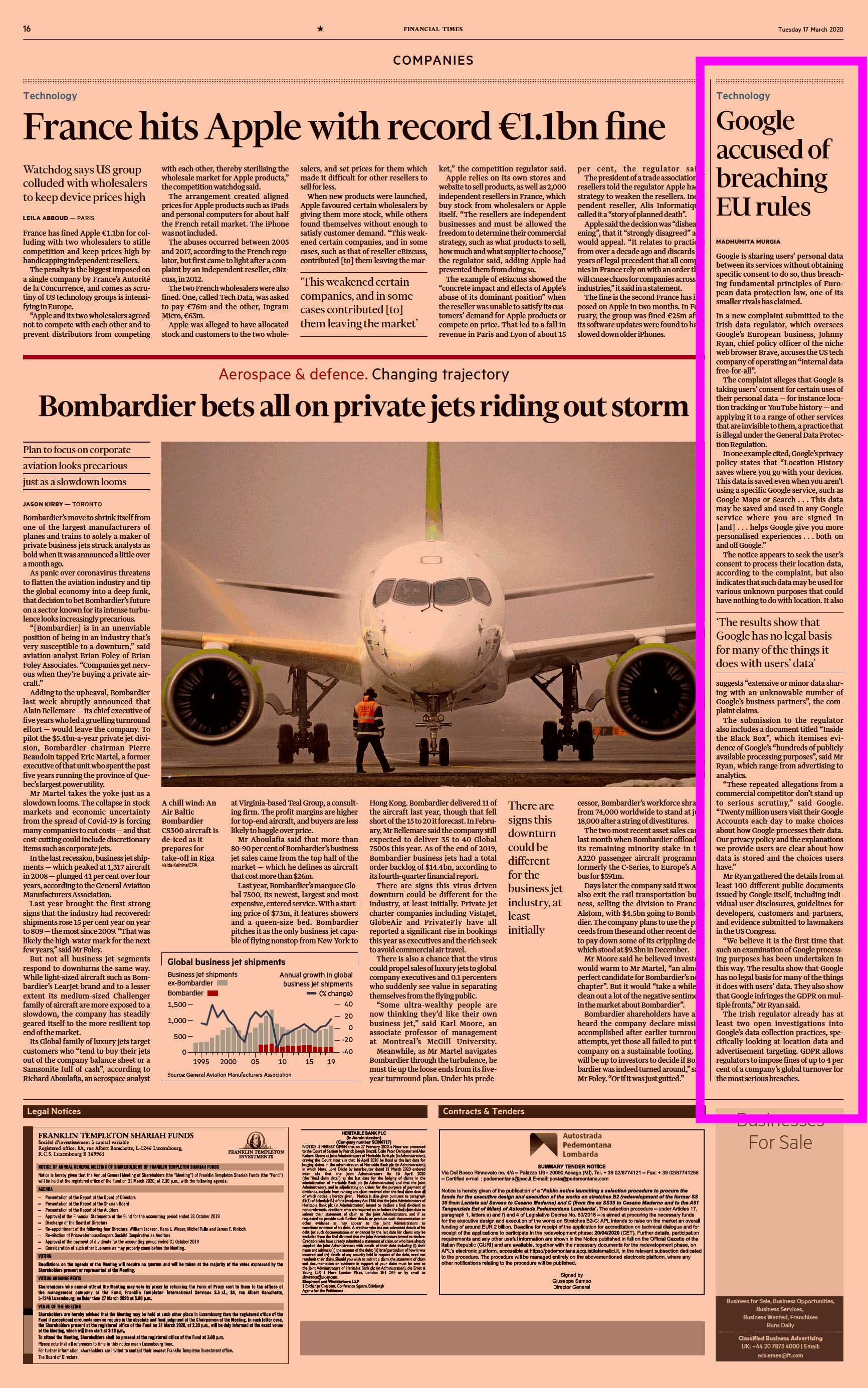
- The Financial Times, Google accused by rival of fundamental GDPR breaches, 16 March 2020
February 2020
- The Guardian, Councils let firms track visits to webpages on benefits and disability, 4 February 2020
January 2020
- Campaign, ICO urges advertisers to consider their role in RTB data breach, 30 January 2020
- Campaign, Is the ICO going soft on the ‘out of control’ adtech industry? 21 January 2020
- Mlex, Comment: Google insulated from adtech lawsuits against ICO as UK inuence wanes, 21 January 2021
- The Irish Times, Make reclaiming your online privacy a priority in 2020, 16 January 2020
December 2019
- Politico, ‘We have a huge problem’: European tech regulator despairs over lack of enforcement, 27 December 2019
- EFF, Behind the One-Way Mirror: A Deep Dive Into the Technology of Corporate Surveillance, 2 December 2019
November 2019
- CPO Magazine, Google Will Restrict Sharing of User Data for Google Ads Under EU Privacy Pressure, 25 November 2019
- Campaign, ICO: adtech players are holding on to personal data, 19 November 2019
- The Wall Street Journal, Google will limit user information it gives to advertisers in concession to EU, 15 November 2019
- The Irish Times, Advertisers warn new data rules will give Google more power, 14 November 2019
- Bloomberg, Google Restricts Data-Sharing for Ads Under Privacy Pressure, 14 November 2019
October 2019
- CPO Magazine, “Widely Used IAB TCF Ad Tracking Consent Framework May Not Meet GDPR Standards” 30 October 2020
- Frankfurter Allgemeine, Ein halbes Jahrhundert im Internet, 28 October 2019
- The Wall Street Journal, European Regulator Turns Up Heat on Ad Tactics Used by Google and Rivals, 16 October 2020
- Politico, Irish privacy watchdog to investigate Facebook data breach, 2 October 2018
September 2019
- The Irish Times, Google’s children’s internet safety grant a bad joke, 26 September 2019
- MLex, Google and adtech industry making ‘really good progress’ on privacy, UK regulator says, 26 September 2019
- Digiday, UK regulator ICO is suddenly everywhere and anywhere with warnings for ad tech, 20 September 2019
- The Drum Brave’s Johnny Ryan and IAB Europe clash over GDPR real-time bidding legality, 13 September 2019
- AdWeek, As GDPR Rocks the EU Ad-Tech World, Vendors Must Learn to Adapt, 22 September 2019
- Computing, Google accused of using secret web pages to leak users’ personal data to advertising firms, 9 September 2019
- NBC News, ‘Ransom’: Google faces antitrust probes — and that’s emboldening some of its critics, 9 September 2019
- Sunday Business Post, Get ready to jump on Google’s great privacy merry-go-round, 8 September 2019
- Corriere Della Sera, Google sotto tiro: multa per Youtube, nuova polemica sull’advertising, 6 September 2019
- The New Indian Express, Reports say Google has been secretly sharing users’ data with advertisers, 5 September 2019
- WARC, Google accused of secret data-sharing, 5 September 2019
- ZDNet, Google accused of leaking personal data to thousands of advertisers, 5 September 2019
- Heise, Browser-Hersteller Brave wirft Google unzulässige Nutzeridentifizierung vor, 5 September 2019
- BBC, Google’s ‘secret web tracking pages’ explained, 5 September 2019
- MLex, Google accused of setting up secret page to help adtech companies gather personal data, 4 September 2019
- Campaign, Google accused of using ‘GDPR workaround’ to feed personal data to advertisers, 4 September 2019
- Forbes, Alleged Global Google Privacy Leak: ‘GDPR Workaround’ Could Incur $5.4B Fine, 4 September 2019
- Forbes, Alleged Global Google Privacy Leak: ‘GDPR Workaround’ Could Incur $5.4B Fine, 4 September 2019
- The Daily Beast, Google Accused of Selling Users’ Personal Data to Ad Companies, 4 September 2019
- Corriere Della Sera, Youtube dovrà pagare 170 milioni per aver violato la privacy dei bimbi (che non riceveranno più pubblicità mirata), 4 September 2019
- The Financial Times, Google’s secret feed to advertisers, 4 September 2019
- The Financial Times, Google accused of secretly feeding personal data to advertisers, 4 September 2019
August 2019
- CPO Magazine, Programmatic Advertising or Problematic Advertising – The Data Protection Case That Tackles the Foundation of the Internet, 30 August 2019
- Mi3, Mr Armageddon: carnage, fines will hit marketers, agencies over adtech, data from GDPR, ACCC, 26 August 2019
- Campaign, IAB launches 2.0 version of controversial adtech standards, 21 August 2019
- Digiday, Google to join IAB’s revamped GDPR framework by next March, 21 August 2019
- De Standaard, Het algoritme, 20 August 2019
- Campaign, ICO tech chief warns reform of real-time bidding is ‘in the balance’, 9 August 2019
- AdExchanger, RTB RIP? The Writing Could Be On The Wall For Real-Time Bidding In Europe, 6 August 2019
- Mlex, Comment: Privacy-based companies seeing growth in post-Cambridge Analytica world, but technology still key, 2 August 2019
July 2019
- Mi3, IAB urges real-time bidding review, 27 July 2019
- Campaign, IAB UK calls for real-time bidding review, 25 July 2019
- Compliance Week, All eyes on how Ireland will handle Big Tech and GDPR, 19 July 2019
- The New York Times, After a data breach, British Airways faces a record fine, July 2019
- The Financial Times, Watchdogs bare their teeth at adtech industry, July 2019
- ProMarket, How the Adtech Market Incentivizes Profit-Driven Disinformation, 2 July 2019
June 2019
- Sky News, Sky Views: Online you’re being weighed and measured and your data spread around, June 2019
- Bloomberg Law, UK data watchdog has ‘systematic’ concerns on real-time bids, June 2019
- TechCrunch, Behavioural advertising is out of control, warns UK watchdog, June 2019
- The Financial Times, Adtech industry operating illegally, rules UK regulator, June 2019
- Sunday Business Post, How Google reaps the data dividend, 2 June 2019
- CNBC, Google faces privacy complaints in European countries, June 2019
- The Register, Brave urges UK’s data watchdog to join Ireland in probing claim Google adtech breaches GDPR, June 2019
- AdExchanger, UK privacy watchdog has its eye on RTB, June 2019
- Marketing Land, UK regulator says real-time bidding violates GDPR, June 2019
- CPO Magazine, Google faces new European investigation over potential GDPR violation, June 2019
- Sunday Business Post, How Google reaps the data dividend, June 2019
May 2019
- Mlex, Comment: Google Ad Exchange probe in Ireland could affect wider targeted advertising, 29 May 2019
- Sunday Business Post, Sexual issues and political search terms dominate Google leak, 26 May 2019
- Mi3, Doubleclick probed as regulators take aim at programmatic, 26 May 2019
- The Irish Times, Has your phone secretly recorded your conversations? Mine has, 25 May 2019
- The Hill, One year later, EU privacy law faces tough questions, May 2019
- The Irish Examiner, Investigation in to possible GDPR breach by Google’s ads, 24 May 2019
- The Guardian, Google faces Irish inquiry over possible breach of privacy laws, 24 May 2019
- Irish Daily Mail, Data protection inquiry into Google’s advertising activity, 24 May 2019
- Los Angeles Times, Irish regulators probe Google over EU privacy concerns, 23 May 2019
- ZD Net (France), Le système publicitaire de Google viole-t-il le RGPD ?, 23 May 2019
- Le Monde, Données personnelles : enquête en Irlande sur les pratiques publicitaires de Google, 23 May 2019
- Wired, Thursday briefing: Ireland investigates Google adtech GDPR breach complaint, 23 May 2019
- The Irish Independent, Google probed over personalised ads, 23 May 2019
- The Irish Independent, GDPR probe launched into Google’s ad business, 23 May 2019
- Mlex, Google under GDPR probe by Irish regulator over adtech data processing, 22 May 2019
- The Verge, Google is facing its first GDPR probe from Irish privacy regulators, 22 May 2019
- Bloomberg, Google Faces Irish Privacy Probe of Data Processing for Ads, 22 May 2019
- The Irish Mirror, Ireland’s Data Protection Commissioner launches investigation into Google’s advertising and compliance with GDPR, 22 May 2019
- The Irish Independent, Irish privacy watchdog opens official probe into Google’s advertising practices, 22 May 2019
- AdWeek, How LiveRamp Intends to Woo Advertisers Now That the Cookie Is Starting to Crumble, May 2019
- Gizmodo, It’s been one year since GDPR scared the crap out of Silicon Valley, what’s next? May 2019
- AdWeek, As CCPA’s Deadline Looms, Tech and Media Brace for Another GDPR, May 2019
- The Financial Times, Google targeted as GDPR hits one year, May 2019
- San Diego Union-Tribune, Google could face hefty fine over possible privacy violations, May 2019
- The Hill, Irish data regulator launches Google probe, May 2019
- Nach Welt, Google steht vor seiner ersten GDPR-Untersuchung der irischen Datenschutzbehörden, May 2019
- The Financial Times, Google ad exchange probed by Irish data regulator, May 2019
- CNet, Google faces EU probe over ad privacy practices, May 2019
- Campaign, Now Ireland is investigating Google over GDPR, May 2019
- The Journal, Data Protection Commission launches investigation into Google Ireland, May 2019
- Bao Dien tu VTV, Google đối mặt với án phạt nặng do xâm phạm quyền riêng tư, May 2019
- Ghana Guardian, Google faces Irish privacy probe of data processing for ads, May 2019
- Skanaa, Google Hadapi Investigasi GDPR Pertama di Eropa, May 2019
- Le Soir, RGPD: la pub en temps réel sur le web pourrait être illégale, May 2019
- Silicon Republic, Irish data protection commission opens investigation into Google Ad Exchange, May 2019
- Slashdot, Google’s ad system under EU probe for how it spreads your private data, May 2019
- Evening Telegraph, GDPR probe launched into Google’s ad business, May 2019
- Computing, Ireland’s Data Protection Commission begins probe against Google over GDPR infringement, May 2019
- MarketingLand, Is GDPR working? Brave’s Johnny Ryan says it’s starting to, and marketers must heed the risks, May 2019
- Mediapost, Google faces scrutiny in Ireland over GDPR, May 2019
- Reuters, Irish regulator opens first privacy probe into Google, 22 May 2019
- Agi, Così Google violava la privacy per passare dati personali alle aziende, May 2019
- B&T, Google In Trouble Following Ad Tech Complaints, May 2019
- IAPP, Two major GDPR complaints: A close-up, May 2019
- Sunday Business Post, Sexual issues and political search terms dominate Google leak, May 2019
- TechCrunch, Google’s lead EU regulator opens formal privacy probe of its adtech, May 2019
- Mail Online, Irish regulator opens first privacy probe into Google, May 2019
- Martech Today, Irish GDPR investigation of Google could impact entire programmatic ecosystem, May 2019
- MarketingLand, GDPR: A ‘Y2K’ moment or a sea change for the digital ecosystem?, May 2019
- Compliance Week, Ireland investigates Google over GDPR, May 2019
- RTE DriveTime (radio), Google investigation, May 2019
- Naked Security, Google ad exchange in data privacy probe, May 2019
- The Irish Times, Has your phone secretly recorded your conversations? Mine has, May 2019
- Politico, Irish privacy watchdog opens investigation into Google, May 2019
- The Irish Times, Data Protection Commission opens first investigation into Google, May 2019
- The Information, Briefing: Ireland launches probe into Google ad data practices, May 2019
- CNBC, EU regulator launches probe into Google over data privacy, May 2019
- Invest in Blockchain, Brave’s top exec to speak at US – massive credibility boost for BAT/Brave project, May 2019
- CNet, Privacy issues roll on because tech giants have no competition, experts tell Congress, May 2019
- Digiday, ‘Privacy horse is sort of out of the barn’: Congress circles close to federal privacy law’, May 2019
- The Register, Irish data cops are shoving a probe right into Google’s ads, May 2019
- Ad Exchanger, Irish regulators begin investigating Google for GDPR infringement, May 2019
- Seeking Alpha, Google faces European privacy investigation via Ireland, May 2019
- The Street, Google is once again in the. EU’s investigative sights over data privacy, May 2019
- The Verge, Google is facing its first GDPR probe from Irish privacy regulators, May 2019
- Bloomberg, Google faces Irish privacy probe of data processing for ads, May 2019
- RTE News, Data protection watchdog to probe Google’s ad exchange, May 2019
- The Irish Independent, Irish privacy watchdog opens official probe into Google’s advertising practices, May 2019
April 2019
- The Irish Times, Complaint lodged over ‘online barrier’ to advertising lobbyist’s website, 5 April 2019
- Mlex, EU digital advertising lobby hit with new data- privacy complaint over ‘cookie wall’, 3 April 2019
March 2019
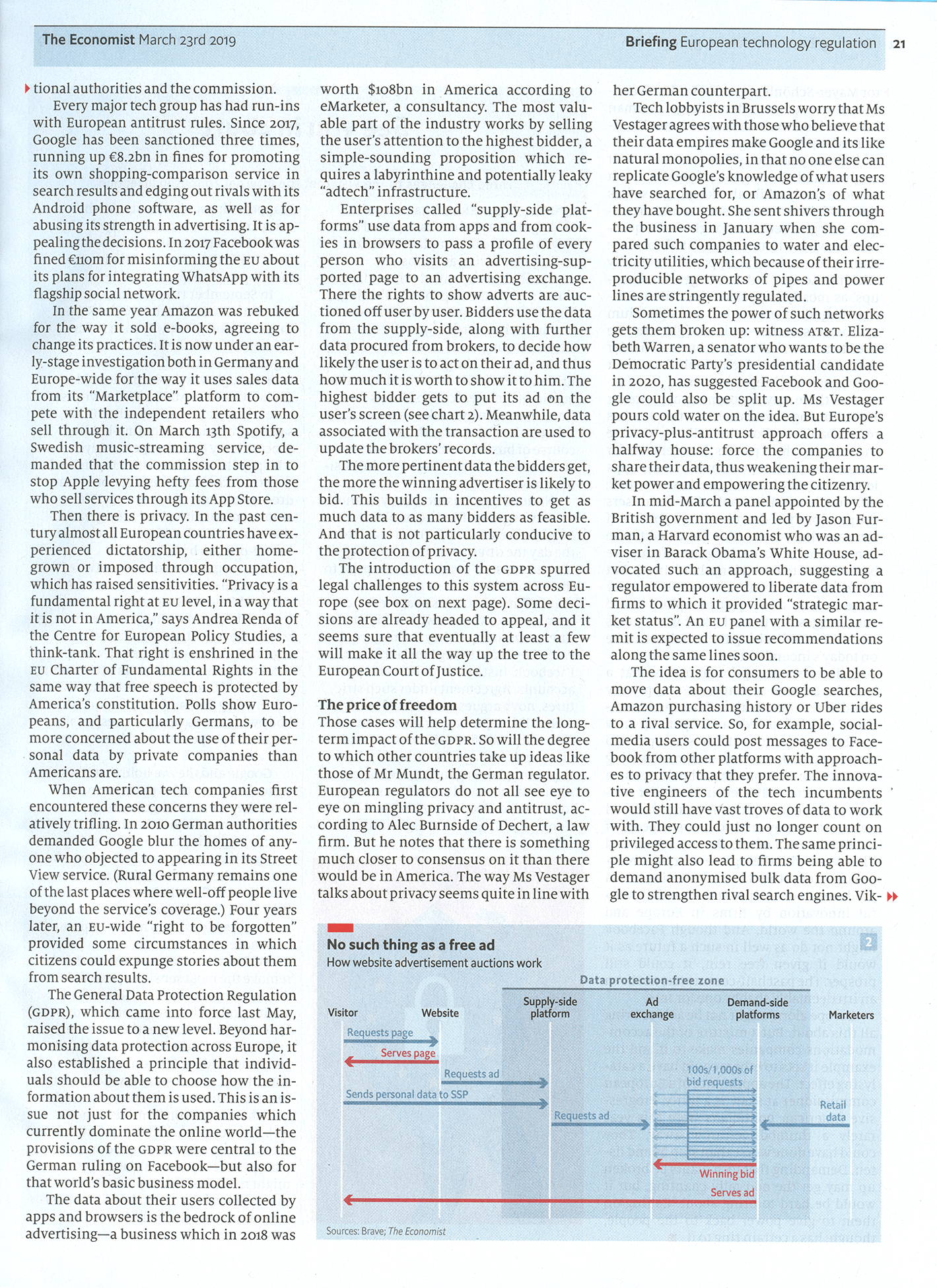
- The Economist, Europe’s GDPR offers privacy groups new ways to challenge adtech, 23 March 2019
- Daily Mail, Google and Facebook get data from NHS websites telling them when users search advice on HIV and abortion, March 2019
- The New Statesman, “I have HIV, now what?” Tracking cookies found on NHS advice pages, March 2019
- The Irish Times, Data from HSE website users ‘leaked to commercial actors’, March 2019
- Euro News, EU citizens ‘are being tracked’ on government and public sector websites, March 2019
- The Irish Times, Information-harvesting software widespread on Government websites, March 2019
February 2019
- Mlex, Facebook at heart of Irish GDPR probes into tech giants, data watchdog says (update*), 28 February 2019
- TechCrunch, Privacy complaints received by tech giants’ favorite EU watchdog up more than 2x since GDPR, February 2019
- Mlex, Google and adtech industry group IAB face new evidence in GDPR complaint, 20 February 2019
- TechCrunch, Even the IAB warned adtech risks EU privacy rules, February 2019
- Mashable, Privacy activists say online ad industry knowingly violated GDPR, February 2019
- Mlex, Google and other adtech companies under UK data-privacy scrutiny, agency head says, 1 February 2019
- The Register, Unearthed emails could be smoking gun in epic GDPR battle: Google, adtech giants ‘know they break Euro privacy law’, February 2019
- The Drum, IAB denies any GDPR wrongdoing as complaints are filed with regulators, February 2019
- The Drum, Privacy activists target the IAB Europe’s GDPR approach, February 2019
- The Register, Ad-tech industry: GDPR complaint is like holding road builders to account for traffic violations, February 2019
January 2019
- The Irish Times, Google rejects targeting allegations, 31 January 2019
- Mlex, Google, IAB Tech Lab complaint sparks debate on data-protection enforcement in ad tech, 30 January 2019
- The Irish Times, New documents back complaints about online advertising, 28 January 2019
- Heise, Programmatic Advertising: Neue Beschwerde gegen personalisierte Werbung, 28 January 2019
- Sina.com.cn, 谷歌追踪用户高度隐私信息发广告 在欧洲遭多起诉讼, 29 January 2019
- The Irish Independent, Tech companies ‘using sensitive personal data to target users for ads’, 29 January 2019
- Fortune, Google and Ad Industry Accused of “Massive” Abuse of Intimate Personal Data, 28 January 2019
- Wired, Privacy groups claim online ads can target abuse victims, 27 January 2019
- The Financial Times, Google and adtech body criticised over data protection, January 2019
- TechCrunch, Google and IAB ad category lists show “massive leakage of highly intimate data”, GDPR complaint claims, January 2019
- Sky News, ‘Male impotence’: How tech firms classify what you read, January 2019
- The Register, Gripe to UK, Ireland, Poland: Ad tech industry inhales, then ‘leaks’ sensitive info on our health, politics, religion, January 2019
- City A.M., Google and IAB hit with fresh complaints over ‘intimate’ user profiling for adverts, January 2019
- Ad Exchanger, Polish Privacy Group Celebrates Data Protection Day With A Nastygram For RTB, January 2019
- Mashable, Google, online ad industry accused of abusing intimate personal data in GDPR complaint, January 2019
- Heise Magazine, Siegeszug der Daten, January 2018
- The Drum, GDPR complaint blasts ‘highly intimate’ Google mental health and male impotence ad labels, January 2019
- Bitcoininist, GDPR can’t stop behavioral ads, but these bitcoin-friendly browsers can help, January 2019
- Computing, Privacy campaigners file new evidence to support claims that Google unlawfully profiles internet users, January 2019
- MediaPost, IAB Tech Lab And Google Criticized In EU By Privacy Advocates, January 2019
- Irish Independent, Tech companies ‘using sensitive personal data to target users for ads’, January 2019
- TechCrunch, Has the fight over privacy changed at all in 2019?, January 2019
December 2018
- Bloomberg, EU’s Vestager Urged to Probe How Tech Giants Cash In on Ads By Aoife White, 3 December 2018
November 2018
- TechDirt, New GDPR Ruling In France Could Dramatically Re-shape Online Advertising, 27 November 2018
- Heise, Versteigerte Werbeplätze: So funktioniert Programmatic Advertising, 16 November 2018
- TechCrunch, How a small French privacy ruling could remake adtech for good, November 2018
- AdExchanger, Is The IAB’s Consent Framework In Trouble?, November 2018
- MarketingLand, Why a French ruling against a small mobile ad firm has ad tech on the defensive, November 2018
- AdExchanger, Privacy Group Asks European Regulators To Test GDPR Against Seven Tech Companies, November 2018
- EthNews, Brave Asks For US Equivalent To GDPR, November 2018
- TechDirt, New GDPR Ruling In France Could Dramatically Re-shape Online Advertising, November 2018
October 2018
- CCN, GDPR is ‘Kryptonite’ to Google and Facebook, Brave Executive Tells EU, October 2018
September 2018
- ZD Net (Japan), ブラウザ新興企業Brave、グーグルなどによるGDPR違反を申し立て, 14 September 2018
- Heise, Angriff auf Werbemarkt: Brave reicht DSGVO-Beschwerde gegen Google ein, 13 September 2018
- Reuters (this report also ran in The New York Times, Yahoo! News, and DailyMailOnline), Mozilla co-founder’s Brave files adtech complaint against Google, September 2018
- Ad Week, As Brave Gears Up to Weaponize Privacy, Google Becomes Its Primary Target, September 2018
- Fast Company, How Google is breaking EU privacy law, according to a new complaint, September 2018
- ZD Net, September Brave browser files GDPR breach complaints against Google in the EU, 2018
- Bits Online, Brave Joins Formal Privacy Complaints Against Google, Others, September 2018
- CNet, Brave browser dumps Google search in France, Germany, September 2018
- The Register, So Brave: Browser biz sics Brit watchdogs on Google’s info slurpage, September 2018
- TechSpot, Pro-privacy company Brave files GDPR complaint against Google, September 2018
- Politiken, EU-sag truer både Google og aviserne, 20 September 2018
- Marketing Tech News, Privacy-browser Brave launches GDPR ad tech ‘test case’ against Google, September 2018
- CoinDesk, Brave Launches Legal Offensive on Google Ads Data Collection Practices, September 2018
July 2018
- Wall Street Journal, Businesses Blast California’s New Data-Privacy Law, July 2018
May 2018
- The Economist, Who will be the main loser from Europe’s new data-privacy law?, May 2018
- The New York Times, What Europe’s Tough New Data Law Means for You, and the Internet, May 2018
- Wired, Why your inbox is crammed full of privacy policies, May 2018
- AdExchanger, ePrivacy: Why Companies Are Underprepared For A Post-GDPR World, May 2018
- AdAge, Playing chicken with regulators: some companies shrug off GDPR, May 2018
- The New York Times, What the G.D.P.R., Europe’s Tough New Data Law, Means for You, 6 May 2018
- GQ, Why there’s a crisis of trust around GDPR, May 2018
- Marketing Week, How GDPR will impact Facebook, Google and online advertising, May 2018
March 2018
- Reuters, Privacy issues emerge as major business risk for Facebook, 20 March 2018
- Martech Today, PageFair on IAB consent framework: ‘Violates GDPR’, March 2018
- Martech Today, Publishers’ trade association on IAB’s proposed framework for GDPR: ‘A non-starter’, March 2018
February 2018
- AdWeek, GDPR: What is it? February 2018
- CNBC, Google flexed its muscles with new ad-blocking rules, and some smaller players are concerned about its power, February 2018
January 2018
- March Today, Ad tech firms join PageFair’s new Perimeter initiative for GDPR-compliant ad targeting, January 2018
- Martech Today, ‘Consent is unworkable’ for programmatic ads in the era of GDPR, January 2018
- DigiDay, With GDPR looming, DSPs are under pressure to adapt, January 2018
- AdExchanger, A Publisher’s Guide To GDPR, January 2018
December 2017
- AdExchanger, As GDPR Looms, Privacy Tech Is On The Rise, December 2017
- Sunday Business Post,Meeting the GDPR challenge, December 2017
November 2017
- AdExchanger,Expect A Contraction Of The Supply Chain In The Leadup To GDPR, November 2017
- The Capitol Forum, Facebook: Core EU Business Potentially at Risk when GDPR Comes into Force in May 2018; Legitimate Interest Exemption Likely Not An Escape Hatch; Privacy Activists Preparing to Sue for Violations, November 2017
- MobileMarketing Magazine, Facebook generated over $700m of its revenue from adblock users, November 2017
October 2017
- AdExchanger, A Marketer’s Guide To GDPR, October 2017
- The Capitol Forum, Google and Facebook: EU’s Draft ePrivacy Regulation Passes Committee and Parliament Vote; Strong Privacy Measures Intact; GDPR, ePrivacy Regulation Pose Risk to Facebook, Google, Other “Surveillance Economy” Participants, October 2017
- Medatel, GDPR: a treat for some, a trick for others, October 2017
- The Drum, What does the EU’s privacy reform mean for US marketers? And what should you do now?, October 2017
September 2017
- Press Gazette, Why the European Union’s General Data Protection Regulation directive could save the journalism industry, September 2017
- Digiday, GDPR is coming, and many U.S. ad tech firms aren’t ready, September 2017
- WARC, How EU data laws will disrupt Google, Facebook, September 2017
May 2017
- El País, Publicidad Bloqueadores de anuncios: ¿el fin de internet?, May 2017
April 2017
- Wired, Stronger Privacy Laws Could Save Advertising From Itself, April 2017
- WARC, How new EU laws may transform digital marketing across the globe, April 2017
- Business Insider, Industry-wide ad blocking could finally acknowledge that online advertising has problems, April 2017
- Le Monde, Google envisage de lancer son propre bloqueur de publicités, April 2017
- Business Insider, Adblocking is leading to ‘the slow death of niches’ on the web, April 2017
- NPR Marketplace, Why would Google want to block its own ads?, April 2017
- The Irish Times, Adblocking tools hit web revenue and traffic, study finds, April 2017
- Mediatel, GDPR set to be a force for good in advertising, April 2017
March 2017
- Knack, (Dutch) Adblockers maken mee de switch van desktop naar mobiel, March 2017
February 2017
- Business Insider, Publishers are trying to stop ad blocker users viewing their content — but there are signs their walls aren’t working, February 2017
- The Australian, Ad-blocking software use on the increase, February 2017
- The Irish Times, Irish internet users rush to embrace ad blockers, February 2017
- Periodismo, (Spanish) El uso de software antipublicidad creció un 30% en 2016, February 2017
- E-zone, (Chinese) Ad-blocker 網民續鬥法 研究:用戶參與一團和氣, February 2017
January 2017
- Mediatel, European Commission proposal will kill third-party cookies, January 2017
December 2016
- AdAge, New EU Data Regulations Will ‘Rip Global Digital Ecosystem Apart’, December 2016
- The Irish Independent, New EU data law could hurt marketers but help publishers, 11 December 2016
- This company has a compelling argument why mobile carriers may never be able to roll out Business Insider, ad blocking in Europe, December 2016
- Motherboard, Why Twitch Is Joining Facebook In Blocking Ad Blockers, December 2016
- Irish Independent, New EU data law could hurt marketers but help publishers, December 2016
November 2016
- Mediatel, Europe’s new privacy rules are about shake adland to its core, November 2016
October 2016
- Financial Times, The persuaders try to convince consumers on ads, October 2016
- NPR MarketPlace, Publishers May Need To Get Past Angst Over Ad Blockers, October 2016
September 2016
- Digital Content Next, “Getting the whole story on ad blocking”, September 2016
August 2016
- Poynter, In the ad-blocking war, publishers gain an important ally in Facebook, August 2016
July 2016
- AdAge, Industry Tries to Figure Out Whether China Just Banned Ad-Blocking, July 2016
- Engadget, Mobile ad blocking is still relatively uncommon in the U.S., July 2016
- Huffington Post, My Loose Theory of Too Much Information: Value of Trust Goes Up, July 2016
- Kompas, (Indonesian) Orang Indonesia Getol Pasang “Adblocker” di Smartphone, July 2016
- Digital Content Next, “Premium publishers, trust, and ad blocking”, July 2016
- Media-Tics, (Spanish) La publicidad va a dejar de financiar al periodismo, July 2016
June 2016
- BBC News, Click looks at ad blockers. As the number of people installing them increases, publishers are hitting back by using ad blocker blockers but where will it all end up? June 2016
- CBC, If you use an ad blocker, you’re killing the internet – an Ira Basen documentary, 24 June 2016
- eMarketer, Mobile Ad Blocking on a Steep Ascent Globally, June 2016
- Beritagar, (Indonesian) 38 juta pengguna gawai di Indonesia benci iklan, June 2016
- Voice Of America, In the Parallel War of Ad Blockers, Privacy Is Lost, June 2016
- Digital Content Next, “Seven steps you can take to manage the risk of ad blocking”, June 2016
May 2016
- NiemenLab, Here are seven possible ways for publishers to deal with adblockers, May 2016
- Journalism.co.uk, Can publishers ‘good-ad’ their way out of the ad-blocking phenomenon?, May 2016
- Mobile Marketing Magazine, Three announces network level ad-blocking trial, May 2016
- NiemenLab, Asia is leading the adoption of mobile adblocking; North America is dodging the bullet (for now, at least), May 2016
April 2016
- Heise, (German) Vodafone denies advertising block plans, April 2016
March 2016
- AdAge, As Technology Defeats Ad Blocking, Online Ads Must Improve, March 2016
- The Drum, Financial Times plots website overhaul to uphold the user experience, March 2016
- HorizonT, (German) Nächster Angriff auf Systemebene, March 2016
- The Drum, Financial Times plots website overhaul to uphold the user experience, March 2016
February 2016
- BBC News, Ad blockers: how online publishing is fighting back, February 2016
- Marketing Land, Things Affiliate & Ad-Dependent Publishers Must Consider In The Age Of Mobile, February 2016
- Heise, (German) “Adblock Action Day” der Verleger: “Adblocking ist wie der Klimawandel”, February 2016
January 2016
- The Drum, Apple ousts in-app ad blocker from the App Store raising questions over its data-sharing plans, January 2016
December 2015
- WARC, “Is ad blocking good for the consumer?”, December 2015
October 2015
- Sky News, Advert-Blocking ‘War’: Whose Side Are You On?, October 2015
- The Globe and Mail, Ad-blocking software threatens growing, critical realm of digital ads, October 2015
September 2015
- Toms Guide, Ad Block Apocalypse? Here’s How to Save the Web, September 2015
- The Drum The Drum Dmexco Highlights: Dr Johnny Ryan, head of ecosystem, PageFair, September 2015
August 2015
- Business Insider, Ad blocking has grown 41% in the past year and it’s costing publishers tens of billions of dollars, August 2015
 Dr Johnny Ryan FRHistS